St Joseph's Roman Catholic College
St Joseph's Teaching Brotherhood bought the site containing the original manor house, Hill House, reputedly once the home of Daniel Defoe, although it appears to have been built after he died. There is a persistent rumour that he attended the non-conformist congregational church while hiding in Tooting during the 17th century 'English Revolution'. The Brotherhood built the College, which opened as a Roman Catholic school in 1887. The upkeep proved too expensive and the school moved to Beulah Hill in 1895.
The photograph of St Joseph's College shows the clock tower and portico that was preserved on the St Benedicts Estate.
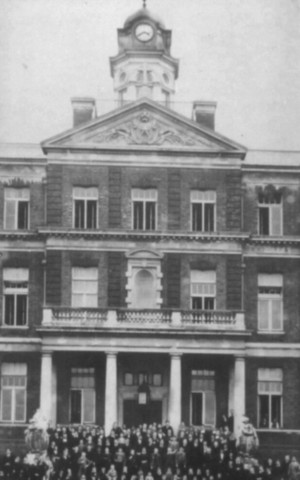
Photograph © St Joseph's College
Tooting Home for the Aged and Infirm
The Wandsworth Board of Guardians bought the site in 1897 to provide extra workhouse accommodation. It cost £40,000 and another £30,000 was spent on alterations to the 3-storey building, which was renamed the Tooting Home for the Aged and Infirm. Hill House became the Nurses' Home.
The ground floor contained the Committee Room and various administrative offices, as well as apartments for the Matron and the Master. There were also two large wards, each containing 42 beds, several smaller wards, some with only seven beds, and a few single rooms used for nursing accommodation. More wards were located on the first floor, where there were also day rooms for patients to spend recreation time. Each of the wards was named after one of the Wandsworth Guardians.
By 1901 the Home housed 605 inmates. In 1903 eight temporary single-storey buildings were erected at the northeast of the site to house a further 102 males and 102 females. These buildings were arranged either side of a central linking corridor, which ran parallel to Church Lane.
As a timing comparison, the London Tramways horse-drawn tram was extended from Clapham to Tooting in 1890 then electrified in 1902.
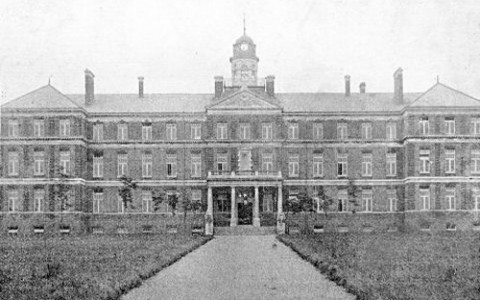
Tooting Home for the Aged and Infirm
Tooting Military Hospital
The War Office took over the home during World War I and it became the Church Lane Military Hospital. After the war the Ministry of Pensions used it as a neurological hospital for shell-shocked and neurasthenic ex-servicemen until 1923. The buildings then became empty and derelict.
As a timing comparison, the London Underground Northern line extension from Clapham Common through Tooting Broadway to Morden opened in 1926.
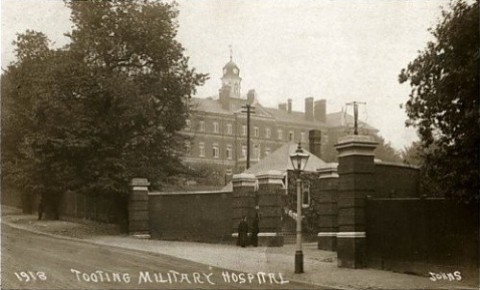
Tooting Military Hospital
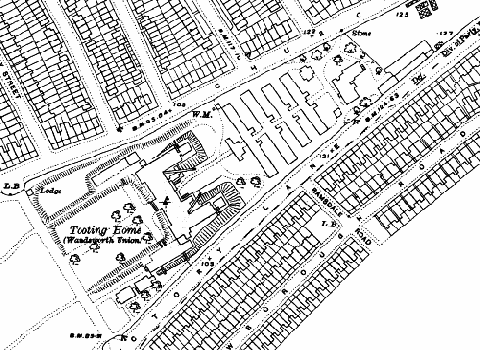
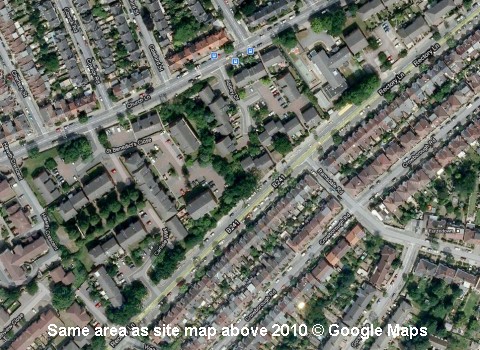
Site map about 1916
St Benedict's Hospital
The London County Council bought the site in 1930. It spent up to £30,000 to renovate and re-equip it as a hospital for long-stay patients. The hospital reopened in 1931 as St Benedict's Hospital. It admitted three classes of patients: convalescents or those needing rehabilitation; the aged chronic sick; and young adults who were permanently incapable. The rehabilitation patients were transferred to Margate in 1938 and much of the activity of the Hospital was reduced, catering for the two remaining classes of patients.
The hospital joined the National Health Service (NHS) in 1948, when it had 200 patients, coming under the control of the Wandsworth Hospital Management Committee, part of the South West Metropolitan Regional Hospital Board. The X-ray Department was improved and a new chapel was built between 1948 and 1950. The hospital had 246 beds in 1950. A further 50 beds were opened for fracture cases from St James' Hospital, Balham (which was then undergoing major rebuilding works, now also closed and redeveloped for housing) and for male patients undergoing rehabilitation in 1951.
As a timing comparison, electric trams were replaced by electric trolleybuses over the approximate period 1937 to 1950 and electric trolleybuses were replaced by diesel-powered buses during the 1960s.
Following reorganisation of the NHS in 1974, the Hospital came under the control of the Wandsworth and East Merton (Teaching) District Health Authority, part of the South West Thames Regional Health Authority. It was latterly used for geriatric care and closed in 1981.
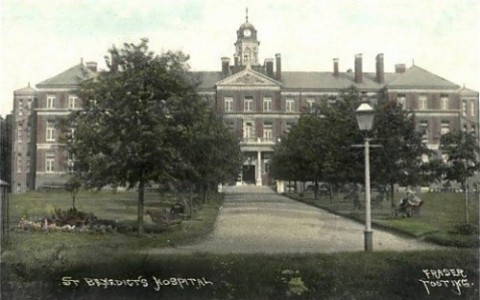
St Benedict's Hospital
St Benedicts Estate
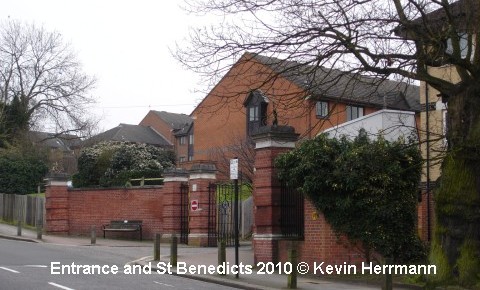
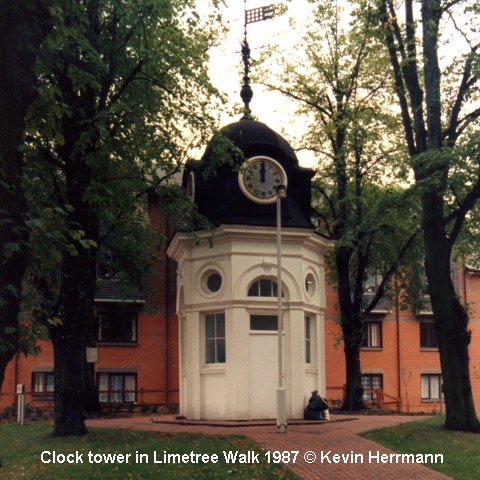
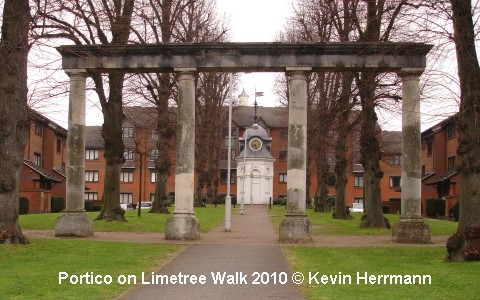
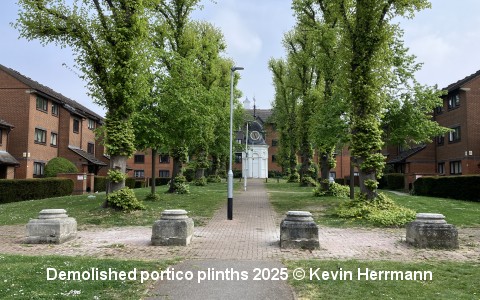
Laing Homes bought the site for housing development in the mid 1980s, reportedly for around £2.2 million. The surviving remnants of the hospital buildings were the entrance posts and gateways on Church Lane and Rectory Lane, the main hospital block's clock tower, which was positioned at one end of Limetree Walk, and the main hospital block's entrance portico, positioned at the other end of Limetree Walk. Wandsworth Council locally listed the clock tower and portico in December 2018. The portico was sadly demolished by a falling tree blown down by extreme winds in storm Henk in January 2024. Unfortunately, modern building regulations do not allow construction as in Victorian times or when it was moved, so re-building could not preserve the historical structure and would have been prohibitively expensive. The Council required the damaged masonry to be cleared for safety, so only the column plinths now remain. There are photographs of the historical structures as Estate features and what remains below.
The first photograph and aerial view replicate as closely as possible the Military Hospital postcard and site map around 1916 above.
The clock tower windows had to be boarded up due to vandalism and it was extensively repaired in 2009 for about £25,000 (comparable to the cost of the site and building work in 1897!) by the Residents' Management Company with the aid of a 50% grant from Wandsworth Council, but such grants are no longer available. It is maintained using traditional materials as far as possible.
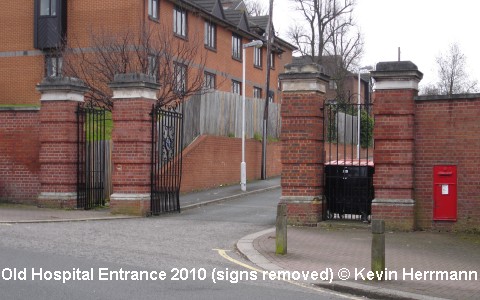
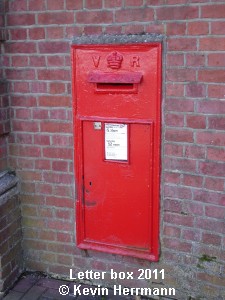
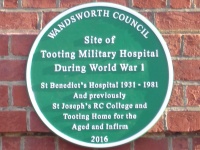
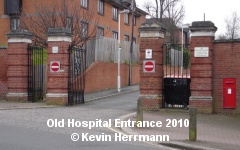
The old Hospital entrances now serve as an exit from Hawthorn Crescent to Church Lane and as access to another housing development on Rectory Lane, neither of which are part of the St Benedicts Estate. The metal decorations on the tops of the pillars have been vandalised and one entrance has been cluttered by signs, which have been digitally removed from the main image. Any text originally on the pillars has faded from view. The letter box on Church Lane appears original, bearing the letters 'VR' (Victoria Regina), as Queen Victoria's reign ended in 1901. Wandsworth Council unveiled a green plaque to commemorate the former buildings on Wednesday 9 March 2016.

References
- Lost Hospitals of London - St Benedict's – ezitis.myzen.co.uk/stbenedicts.html
- The Workhouse - Wandsworth and Clapham – www.workhouses.org.uk/Wandsworth/ [Updated May 2012]
Text © 2011-2025 Kevin Herrmann, formerly Director of St Benedicts (Tooting) Management Company Ltd, with acknowledgement.

